 EN
EN

Introduction
Central Asia's car market crossed a quiet but important line in 2026. For years, the region's five countries — Kazakhstan, Uzbekistan, Kyrgyzstan, Tajikistan, and Turkmenistan — were treated by most exporters as a single, slow-moving bloc where gasoline sedans ruled and electrification was a rounding error. That assumption no longer holds. In the first four months of 2026, new energy vehicle (NEV) sales in Kazakhstan rose nearly fivefold year-on-year, while Uzbekistan quietly became the electrification leader of the wider Eurasian region. At the same time, combustion vehicles still account for the overwhelming majority of units sold across the region. For overseas dealers sourcing from China, understanding exactly where the split lies — and why — has become essential to building the right inventory mix for 2026 and beyond.
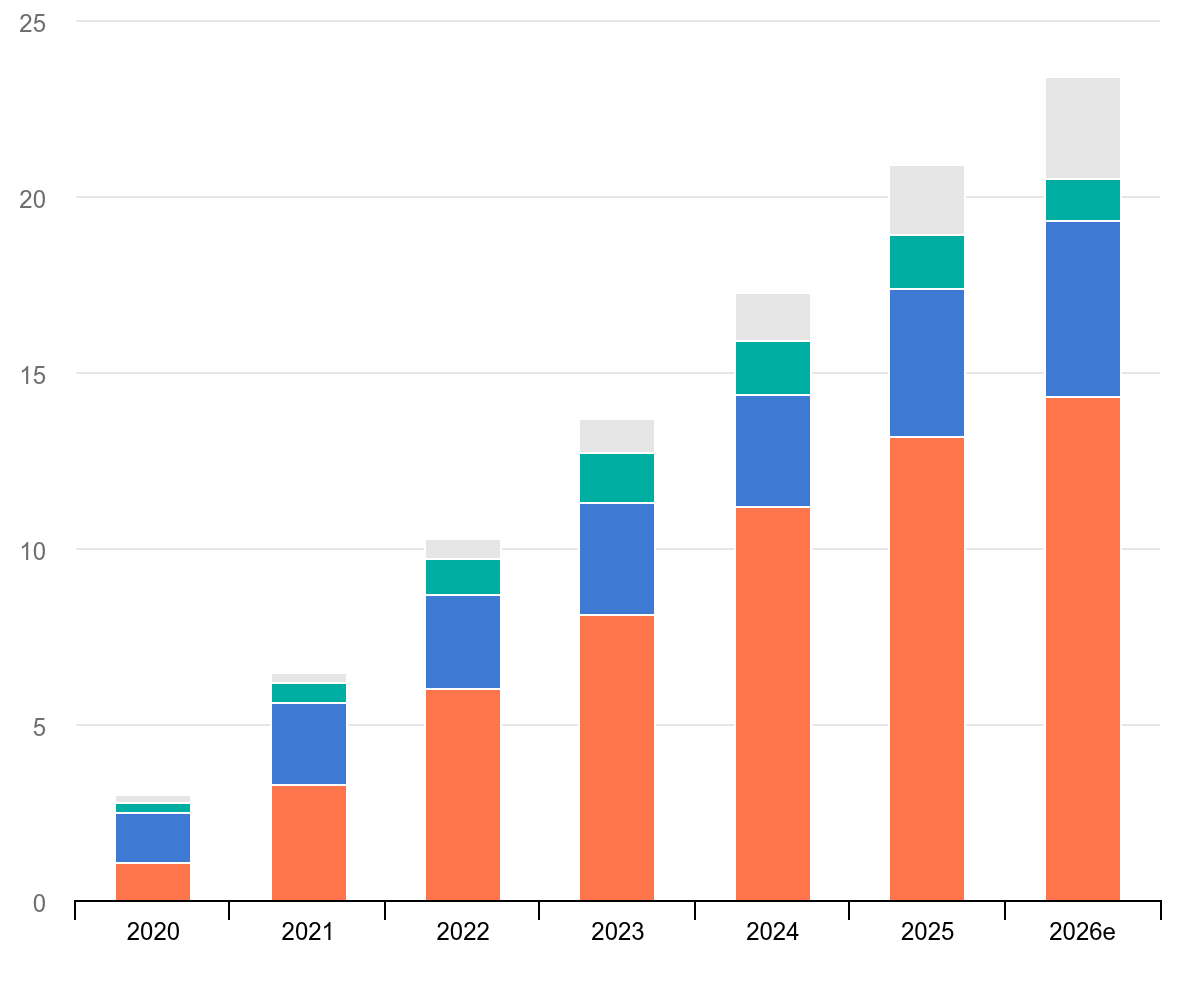
Global electric car sales, 2020-2026
A Market at an Inflection Point: 2026 by the Numbers
Central Asia is home to more than 80 million people across five countries with distinct fiscal regimes, currencies, and industrial policies, and its two largest markets are both posting record volumes in 2026. Kazakhstan sold a record 207,616 new vehicles between January and November 2025, breaking the previous annual record of roughly 205,000 units set in 2024, and Q1 2026 volumes grew a further 9.7% year-on-year to 51,511 units. Vehicle production is following the same trajectory: the Kazakhstan Automobile Union projected total output could exceed 209,000 units in 2026, up from 171,400 in 2025.
Uzbekistan's market, while more mixed, is also expanding. Q1 2026 sales reached 76,614 units, a modest but steady 1.7% year-on-year gain after a sharper downturn in prior years. What makes 2026 different is not just the top-line volume — it's the composition underneath it. Within Kazakhstan's total sales, the NEV segment (which includes battery-electric, plug-in hybrid, and extended-range electric vehicles) posted 2,122 unit sales in the January–April period alone, close to five times the same period a year earlier. That is a structural shift happening inside an already-growing market, not a substitute for it.
Why Chinese EVs Are Winning Central Asia
The single biggest driver behind this shift is the entry of competitively priced Chinese electric and hybrid brands. In Kazakhstan, BYD held roughly 63.6% of the EV segment in Q1 2026 after growing sales by more than 450% year-on-year, while other Chinese brands also gained share in the same period. In Uzbekistan, the concentration is even sharper: BYD's share of the country's EV segment reached 96.2% in early 2026, effectively making the brand synonymous with electrification in the local market.
This is not simply a pricing story. Chinese manufacturers have also matched their products to Central Asian conditions — long inter-city distances, harsh winters, and inconsistent charging infrastructure — by leaning heavily into plug-in hybrid and extended-range models rather than pure battery-electric vehicles. In Kazakhstan's NEV segment, hybrid and extended-range models accounted for 1,499 of the 2,122 units sold in the first four months of 2026, compared with 623 fully electric units. For dealers building a catalog for this region, that ratio is a more useful planning signal than headline "EV growth" numbers, which can overstate readiness for pure battery-electric vehicles. Chinese Brands Drive Fivefold Surge in Kazakhstan’s Electric and Hybrid Vehicle Sales
Kazakhstan vs. Uzbekistan: Two Different Playbooks
The two largest markets are pursuing electrification through very different policy paths, and dealers who treat "Central Asia" as one homogenous market risk misreading both. Kazakhstan spent 2024–2025 growing its EV base through customs duty exemptions for individual buyers, capped at a 15,000-vehicle quota. That quota has now been filled, and starting January 1, 2026, individual EV buyers face a 16% VAT that industry estimates suggest could raise EV prices by 30–40%. Registered EVs in the country had already reached around 19,000 units by mid-2025, but the removal of the exemption is expected to slow the pace of new adoption even as hybrid and extended-range models continue growing quickly.
Uzbekistan has taken the opposite approach, expanding rather than withdrawing support: the government is offering subsidized loans at roughly 16% interest for EV buyers, planning to expand charging infrastructure to around 4,000 stations, and maintaining tax incentives. Uzbekistan has also gone further on the industrial side, hosting an EV production joint venture between BYD and local manufacturer UzAuto Motors — giving it a manufacturing base that Kazakhstan currently lacks for electric models, even though Kazakhstan's Kostanai plant, run by the Allur Group, already assembles combustion and hybrid vehicles for Chevrolet, JAC, Chery, Kia, and Hyundai and covers roughly 70% of Kazakhstan's domestic market through local production.
The Smaller Markets Are Growing Fastest, From a Small Base
While Kazakhstan and Uzbekistan dominate absolute volume, the region's smaller markets are posting the sharpest percentage growth in Chinese vehicle exports. In the January–February 2026 period, Kyrgyzstan's imports of Chinese passenger vehicles grew 205.1% year-on-year, and Turkmenistan's grew 74.4%, both outpacing the steadier expansion seen in Kazakhstan and Uzbekistan. Kyrgyzstan and Tajikistan combined accounted for more than 30% of electric vehicle sales across the wider Eurasian region in 2025, a disproportionately large share for two of the smaller economies in Central Asia.
Much of this growth is tied to the role these countries play as regional distribution and re-export points rather than purely as end markets. Kyrgyzstan's capital, Bishkek, in particular, has become a logistics and showroom hub that overseas dealers increasingly use as a base for sourcing and re-distributing vehicles across neighboring markets — a pattern that mirrors how exporters with regional trading infrastructure, including CarX Global's own Bishkek showroom, are positioning inventory closer to these fast-growing but still-thin markets.
Combustion Vehicles Still Dominate — For Now
None of this electrification data should obscure the core fact: gasoline and diesel vehicles remain the large majority of what Central Asia actually buys. In Uzbekistan, Chevrolet alone held roughly 77% of the total passenger vehicle market in Q1 2026, almost entirely on the strength of combustion models like the Chevrolet Cobalt and Damas. Even in the electrified segment, pure battery-electric vehicles represent a minority — around 33% of EV sales in Uzbekistan, well below markets like those in Southeast Asia where BEVs account for more than 90% of electric car sales.
The practical takeaway for dealers is that "electrification" in Central Asia right now means a broadening product mix, not a replacement cycle. Combustion and hybrid SUVs, sedans, and light commercial vehicles suited to long distances and cold climates remain the volume backbone of the region, while NEVs — led by hybrids and extended-range models more than pure BEVs — are the fastest-growing segment layered on top of that base.
What This Means for Overseas Dealers Sourcing from China
For dealers building 2026 inventory plans, the data points toward a mixed-fleet strategy rather than an all-in bet on either combustion or electric. Kazakhstan's tightening EV incentives suggest near-term demand there may lean back toward hybrids and combustion models in the individual-buyer segment, while Uzbekistan's continued subsidies and local BYD production point to sustained electric demand, particularly for plug-in hybrid and extended-range models suited to the region's climate. Smaller markets like Kyrgyzstan and Turkmenistan, growing fast off a low base, reward dealers who can move quickly and source flexibly rather than commit to large single-model orders.
Exporters like CarX Global, which maintain warehouse capacity in Khorgos and Kashgar alongside a showroom presence in Bishkek and Tashkent, are positioned to support exactly this kind of flexible, mixed-fleet sourcing — supplying combustion, hybrid, and electric models from the same regional network rather than forcing dealers to choose one category. All shipments are handled on EXW or FOB terms, giving dealers a transparent cost structure from the point of departure without CarX Global taking on downstream freight or customs roles. For dealers evaluating how to structure a Central Asia sourcing strategy for the rest of 2026, reaching out to CarX Global's regional team is a practical starting point for matching specific vehicle categories to the market conditions described above.
Table of Contents
- Introduction
- Global electric car sales, 2020-2026
- A Market at an Inflection Point: 2026 by the Numbers
- Why Chinese EVs Are Winning Central Asia
- Kazakhstan vs. Uzbekistan: Two Different Playbooks
- The Smaller Markets Are Growing Fastest, From a Small Base
- Combustion Vehicles Still Dominate — For Now
- What This Means for Overseas Dealers Sourcing from China
