 EN
EN

Intro
Oil prices spiking, gasoline getting more expensive in some markets, and Chinese automakers suddenly looking a lot more interested in the Gulf — that's the short version of what's been happening in the Middle East EV market since early 2026. If you're sourcing vehicles for a Middle East market, this isn't just a headline about energy geopolitics. It's a fairly concrete signal about where demand and supply are both moving, and it's worth understanding before your competitors lock in the good inventory.
Why Demand Is Surging Right Now
The proximate trigger is straightforward: the energy shock stemming from the 2026 Middle Eastern conflict is expected to help Chinese EV makers exceed their overseas expansion targets this year, according to industry analysts. Higher fuel prices — and gasoline shortages in some markets — change the math on running a combustion vehicle versus an EV in ways that are hard to ignore for your cost-conscious buyers. One Shanghai-based consultancy managing director compared the moment to the 1970s oil crisis that helped fuel-efficient Japanese cars break into markets they hadn't previously dominated. South China Morning Post1
Chinese manufacturers are leaning into it. Major carmakers including BYD and Geely have been shifting sales focus overseas as they face an intense price war and tighter regulation at home, and BYD recently raised its overseas sales target for the year to 1.5 million units, up from an earlier forecast of 1.3 million, after selling 1.05 million units abroad in 2025. This isn't a one-market story either — Chinese imports accounted for 55% of electric car sales globally in 2025, up from roughly 10% in 2021, and many countries across Latin America, the Middle East, and Africa now import more than 80% of their electric cars from China. South China Morning Post1
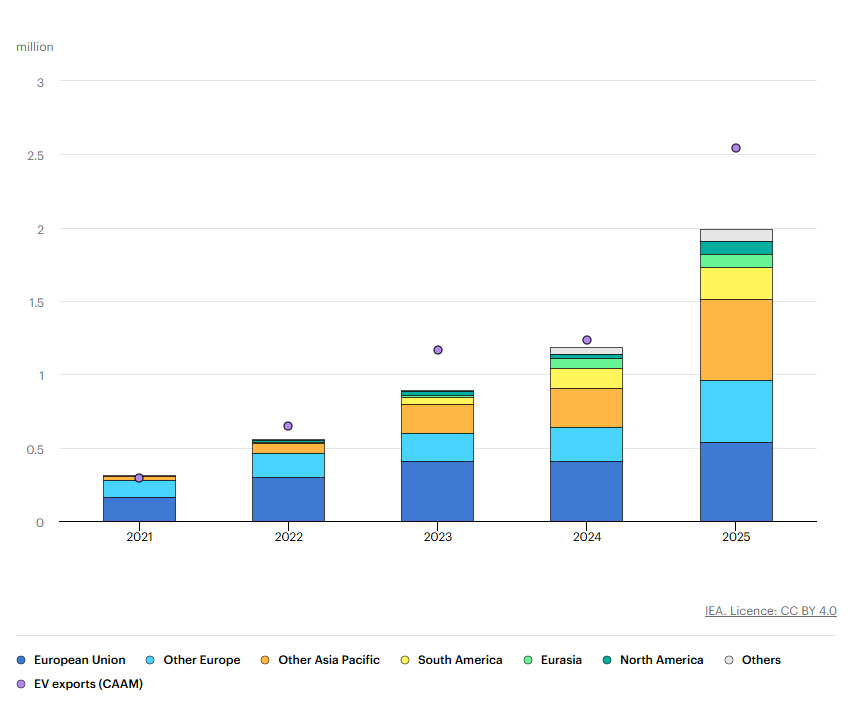
There's also a supply-side push worth understanding, because it affects your pricing leverage. China's 2025 production of 16 million electric cars outstripped domestic demand by 20%, which pushed Chinese EV exports to double to a record high of more than 2.5 million units. In other words, this isn't purely demand-pulled growth — Chinese manufacturers have real overcapacity to move, which has generally kept export pricing competitive for buyers willing to commit to volume. IEA2
Sales of Chinese-made electric cars outside China by region, 2021-2025
The Regional Pull Factor: Why the Middle East Specifically
It's not just that Chinese EVs are being pushed outward — your region is also actively pulling investment in. Middle East and North Africa countries received less than 2% of China's global EV foreign direct investment during 2021–2023, but that share jumped to 25% by 2024, largely as Chinese companies redirected focus away from Europe and the US amid tightening trade barriers there. That's a five-fold-plus increase in strategic attention on your market in under three years — worth factoring into how you think about long-term supplier relationships, since manufacturers are increasingly building service networks, parts pipelines, and local partnerships specifically with this region in mind rather than treating it as a secondary market. European Council on Foreign Relations3
Saudi Arabia and the UAE are backing this up with real infrastructure spending. Saudi Arabia's Vision 2030 program has attached serious money to EV adoption — reports point to a government investment package in the range of $20 billion targeted at EV infrastructure through 2030, alongside a separate estimate of over $50 billion committed toward EV manufacturing and infrastructure more broadly, with the Public Investment Fund playing a leading role. The country's homegrown EV brand Ceer, backed by PIF and partnered with BMW and Foxconn, is targeting its first model launch in Q4 2026, and Lucid's manufacturing plant in King Abdullah Economic City adds another local production anchor. A government target of 40% local content for EV manufacturing signals Saudi Arabia wants to become a regional EV hub, not just a consumer market — worth thinking about now if component sourcing and after-sales support are going to concentrate there over the next few years.
The UAE tells a similar story on the charging side. Its EV charging infrastructure market generated an estimated $71.4 million in 2025 and is projected to grow at a compound annual rate of around 16–18% through 2032–33, positioning the UAE as the fastest-growing charging infrastructure market in the wider Middle East and Africa region. Fast chargers already led revenue generation there in 2025 — a meaningful signal that buyers in the UAE aren't just testing EVs, they're building the daily-use infrastructure that supports real ownership, not novelty purchases.
What This Means for Your Sourcing Strategy
A few practical takeaways follow from this shift, and they matter more for margin than headline growth numbers do:
1) The pricing window favors buyers who can commit to volume. With Chinese manufacturers sitting on real overcapacity, dealers negotiating meaningful order sizes are in a stronger position than those buying small, opportunistic batches. This is a good moment to lock in supplier relationships rather than shop spot-market.
2) Infrastructure readiness varies sharply by country — plan inventory accordingly. Saudi Arabia and the UAE are investing heavily in charging networks, but that build-out is uneven: one Saudi source put public charger counts anywhere between roughly 100 and over 1,000 depending on methodology, which tells you the market is still maturing rather than mature. If you're selling into markets with thinner charging coverage, a heavier mix of plug-in hybrids alongside pure EVs may make more sense until infrastructure catches up, rather than assuming full-BEV demand looks the same everywhere.
3) After-sales support is becoming a differentiator, not an afterthought. As Chinese brands deepen their regional investment — new showrooms, service centers, and local partnerships — dealers who can offer buyers confidence around parts availability and service access will convert interest into closed sales faster than those competing on price alone.
4) Fuel-cost math is your best sales argument right now. With gasoline prices elevated in several markets tied to the broader energy shock, the operating-cost gap between EVs and combustion vehicles has widened in ways that are easy to explain to a buyer on your lot. This is a straightforward, numbers-based pitch that doesn't require selling on brand or novelty.
5) Watch which cities are getting the infrastructure investment first. Riyadh, Jeddah, and Al Khobar are seeing concentrated charging build-out in Saudi Arabia, and similar concentration is likely across major UAE cities. Matching inventory delivery timing to these hubs, rather than spreading thin across a whole country, tends to produce faster turnover.
Risks and Headwinds to Watch
This opportunity isn't without complications. The current export surge is partly a reaction to an active geopolitical conflict — if the situation de-escalates and oil prices normalize, some of the urgency behind the EV shift could ease, though the underlying cost-of-ownership advantage for EVs would likely remain. There are also signs of building overseas inventory that could eventually slow the pace of export growth, alongside a high base from the second half of 2025 that analysts expect to moderate the current rate of expansion.
Trade policy is another factor to track. Chinese automakers have already faced tightening measures in Europe — including minimum import price commitments and export quota agreements from at least one major joint venture — and while the Middle East hasn't shown comparable protectionist moves yet, it's worth keeping an eye on how quickly the region's own domestic manufacturing ambitions (Saudi Arabia's 40% local content target, for one) could eventually translate into preferences for locally assembled vehicles over pure imports.
Finally, infrastructure inconsistency is a real operational risk, not just a market-sizing footnote. Conflicting data on charger counts in Saudi Arabia is a reminder to verify local charging coverage directly — through site visits or local partners — rather than relying on regional market reports when making inventory and location decisions.
Outlook
The Middle East is shifting from a market where Chinese EVs were a curiosity to one where they're becoming a default option — backed by real government infrastructure spending, rising manufacturer investment, and a fuel-cost argument that's currently working in EVs' favor. Dealers who move now, with supplier relationships built for volume and inventory matched to where charging infrastructure is actually landing, are positioned to capture a market that's still in its early innings relative to where Saudi Arabia and the UAE's stated 2030 targets are headed.
CarX Global supports dealers sourcing new energy and conventional vehicles across the Middle East, Africa, Central Asia, and South America, with a regional showroom in Dubai alongside warehouse capacity in Guangzhou Nanshan, Khorgos, Kashgar, and Qingdao. All transactions are handled on EXW or FOB terms, giving you a transparent view of vehicle cost at the point of factory or port handover. If you're evaluating EV sourcing for your market, the CarX Global regional team can walk through current model availability and lead times.
